
Choosing the right trim size for your book is one of the most important decisions in the book formatting process. Trim size affects your margins, page count, printing cost, and even how your book looks beside others in your genre. If you’re still learning the basics of layout and print setup, you may want to start with our Complete Book Formatting Guide before choosing your final trim size.
You have written the book.
You have revised it.
You may have even formatted it.
And then you hit a screen inside Amazon KDP that asks for your trim size.
Suddenly you are staring at a list of numbers like 5 x 8, 5.5 x 8.5, 6 x 9, and wondering why no one warned you that book size is a decision.
Trim size sounds technical, but it is actually simple.
It is the final width and height of your printed book.
That is it.
When your book is trimmed after printing, that final physical measurement is the trim size.
But here is the part no one explains clearly. Many of the problems authors run into later come from small layout decisions made early in the process. These are some of the most common formatting mistakes new authors make.
Trim size affects everything.
Your margins.
Your page count.
Your spine width.
Your printing cost.
Your pricing.
Even how professional your book looks next to others in your genre.
So let’s walk through this calmly and clearly.
No overwhelm. No panic.
Just smart decisions.
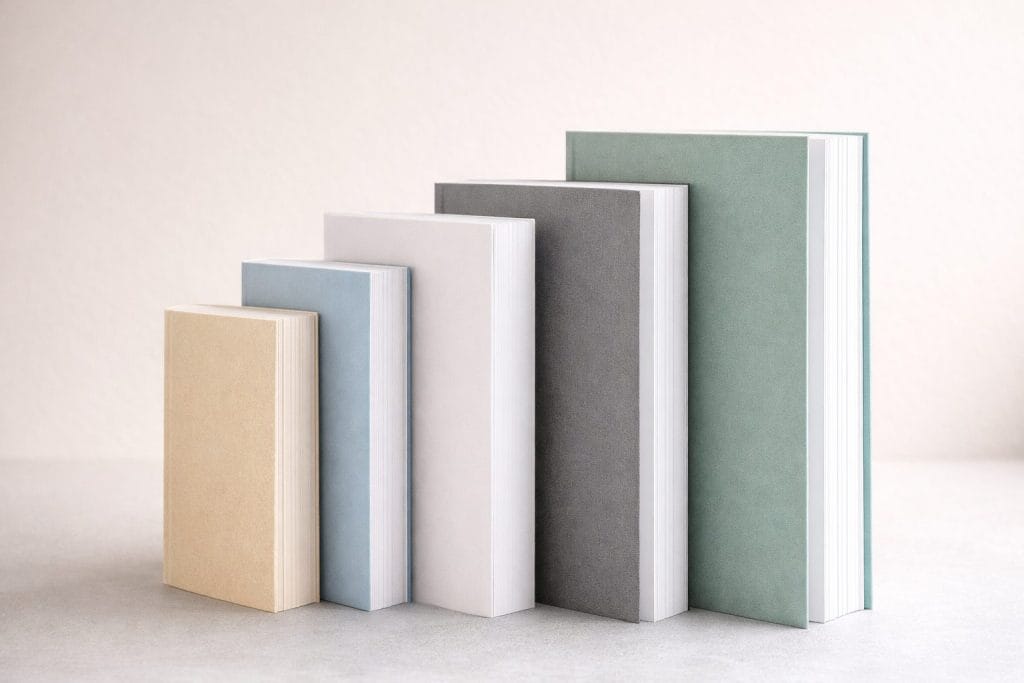
What Trim Size Actually Means
Trim size is the physical dimension of your finished book.
When you see 6 x 9, that means six inches wide and nine inches tall.
If you walk into a bookstore and pick up a standard paperback novel, there is a strong chance it is either:
5 x 8
5.5 x 8.5
6 x 9
Those are the most common sizes in indie publishing.
There are others, especially for children’s books, workbooks, or photography books, but for most fiction and nonfiction authors, you will choose from those three.
Trim size is not decorative. It is structural.
Once you choose it, your interior file must match it exactly.
If your PDF is built for 6 x 9 and you select 5 x 8 inside KDP, your upload will be rejected.
That is why this decision comes early in formatting, not at the last minute.
Why Trim Size Matters More Than You Think
At first glance, the difference between 5.5 x 8.5 and 6 x 9 feels tiny.
Half an inch. No big deal.
But that half inch changes:
How many words fit on a page
How many pages your book ends up with
How thick your spine is
How much it costs to print
How it feels in someone’s hand
A smaller trim size means fewer words per page.
Fewer words per page means more pages.
More pages means a thicker spine.
A thicker spine means a higher printing cost.
That is not dramatic. It is just math.
So choosing trim size is partly aesthetic and partly financial.
The Most Common Trim Sizes and When to Use Them
Let’s break down the three most common sizes.
5 x 8
This is compact. Cozy. Easy to hold.
It is often used for:
Short novels
Poetry collections
Novellas
Memoirs with lower word counts
Because the page is smaller, your book will likely have more pages than it would at 6 x 9. That can make a shorter manuscript feel more substantial.
It also feels intimate. Some authors love that.
The trade off is printing cost. More pages means more cost per copy.
5.5 x 8.5
This is a middle ground.
It is slightly roomier than 5 x 8 but still feels like a traditional paperback novel.
It works well for:
Genre fiction
Romance
Fantasy
Thrillers
General nonfiction
If you want something that feels bookstore standard without going large, this is a safe choice.
6 x 9
This is the most common size for indie publishing.
It is clean, spacious, and efficient.
Because the page is larger, you fit more words per page. That usually means fewer total pages and lower printing costs.
It is very common for:
Nonfiction
Business books
Self help
Longer novels
Debut indie authors
If you are unsure and want a practical default, 6 x 9 is rarely wrong.
How Genre Influences Trim Size
Readers have subconscious expectations.
Romance readers expect a certain feel.
Epic fantasy readers expect a thicker book.
Business readers expect a larger trim with generous margins.
If your book looks dramatically different from others in your category, it may feel off even if readers cannot explain why.
A good exercise is this:
Search your genre on Amazon.
Click into paperback listings.
Scroll to the Product Details section.
Look at the listed dimensions.
You will start to see patterns.
Matching genre expectations is not about conformity. It is about signaling professionalism.
Trim Size and Page Count
This is where things get practical.
Let’s imagine your manuscript is 80,000 words.
At 6 x 9 with standard margins and font size, it might land around 280 to 320 pages.
At 5 x 8, that same manuscript might be 350 to 400 pages.
That affects:
Spine width
Cover dimensions
Printing cost
Perceived length
A very thin spine can look awkward on a bookstore shelf.
A very thick spine increases cost.
Neither is good or bad. They are simply factors to consider.
If your book is under 40,000 words, choosing a smaller trim size can prevent it from looking too thin.
If your book is 120,000 words, a larger trim size may prevent it from becoming excessively bulky.
How Trim Size Affects Your Cover
This is where authors often get tripped up.
Your cover dimensions depend entirely on:
Trim size
Page count
Paper type
Spine width is calculated based on page count and paper thickness.
If you change trim size after designing your cover, the entire cover must be resized.
That includes:
Front
Back
Spine
So do not design your cover before choosing trim size.
Choose trim size first. Format the interior. Confirm final page count. Then finalize your cover dimensions.
That order prevents headaches.
Printing Costs and Royalties
Printing cost is based on:
Page count
Trim size
Ink type
Larger pages with fewer total pages often cost less than smaller pages with more total pages.
That can influence pricing.
If your paperback costs more to print, your royalty per sale may shrink unless you raise the list price.
There is nothing wrong with that, but it should be intentional.
Before locking in a trim size, you can:
Upload a draft interior
Check estimated page count
Use the KDP printing calculator
This gives you a realistic picture before you commit.
Common Trim Size Mistakes
Let’s save you from a few avoidable problems.
Choosing a trim size because it sounds nice
Ignoring genre norms completely
Formatting for one size but selecting another during upload
Designing a cover before confirming page count
Switching trim size late in the process
The earlier you decide, the smoother everything goes.
So How Do You Actually Choose?
Here is a simple decision framework.
If you are writing fiction and want safe and standard, choose 5.5 x 8.5 or 6 x 9.
If your manuscript is long and you want to control printing cost, choose 6 x 9.
If your manuscript is shorter and you want it to feel substantial, consider 5 x 8.
If you are writing nonfiction, especially instructional content, 6 x 9 is usually the most practical.
And if you are still unsure, study your category and follow the pattern.
There is no prize for being unusual here.
There is value in looking like you belong.
What About Hardcovers?
Hardcover trim size follows similar logic, but many indie authors begin with paperback only.
If you plan to release hardcover as well, choose a trim size supported by your platform for both formats. Most common sizes are available in paperback and hardcover through KDP and IngramSpark.
Again, consistency matters more than novelty.
Final Thoughts
Trim size is not glamorous.
It does not feel creative.
But it is one of those quiet structural decisions that makes everything else easier.
Once chosen, it informs your layout.
Your margins.
Your spine.
Your cover.
Your pricing.
It is a foundational choice.
The good news is this.
There is no perfect size. There is only appropriate size.
Choose based on genre.
Choose based on word count.
Choose based on practicality.
Then move forward confidently.
You have bigger things to focus on than half inches of paper.
If you would like a follow up guide on margins, interior spacing, or how to format correctly for 6 x 9 specifically, that is a natural next step.
One smart structural decision at a time.
That is how professional books are built.

You might also enjoy:
Complete Book Formatting Guide
How to Format Your Book for Kindle or Print
What Does “Formatting” Even Mean? (For Real.)
Common Formatting Mistakes New Authors Make